Understanding Psilocybin Dosage: Why the Number on the Scale Is Only Part of the Story
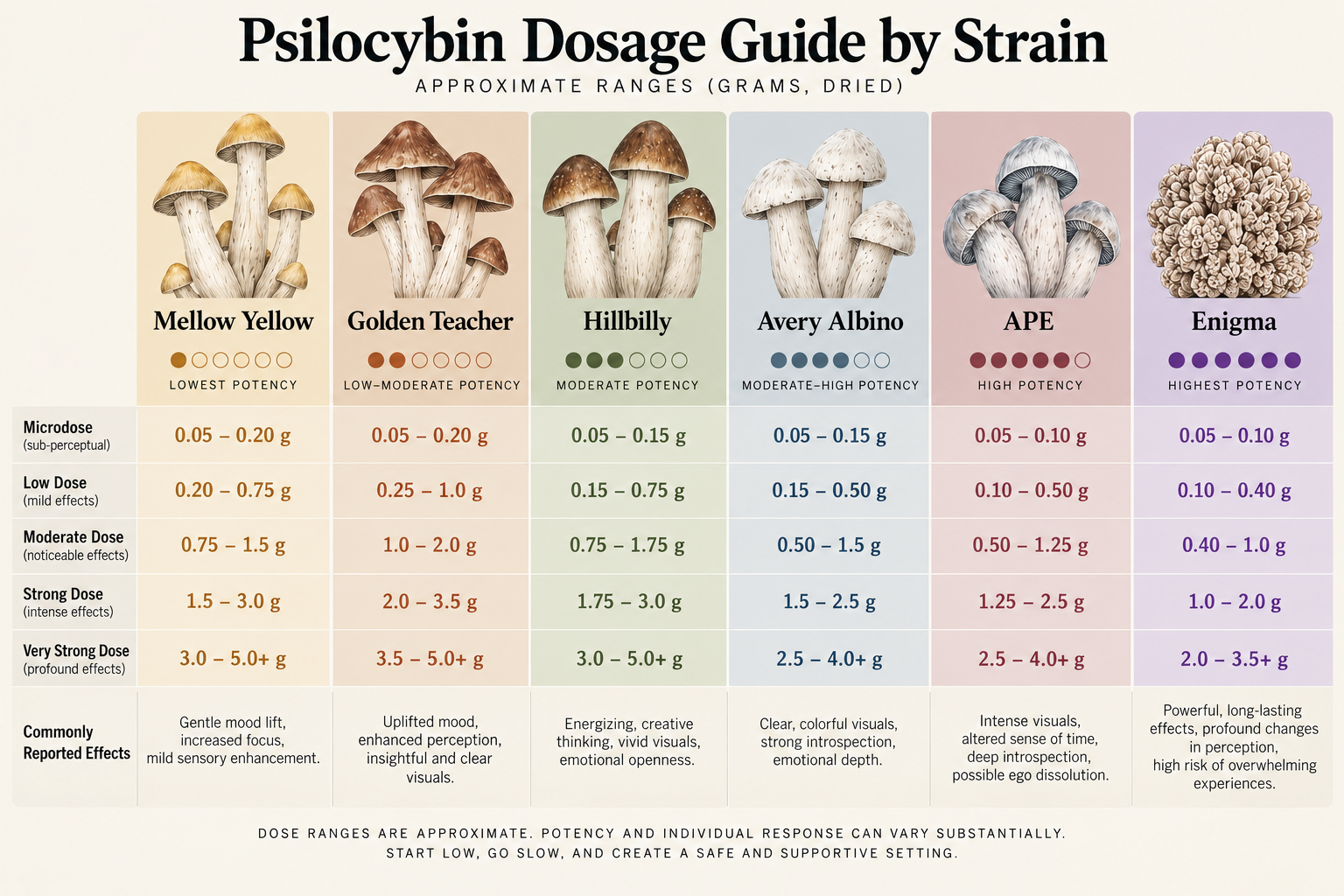
When people talk about consuming psilocybin mushrooms, dosage is usually discussed in grams: 0.2 grams, 1 gram, 3.5 grams, and so on.
That makes dosage sound more predictable than it actually is.
A gram measures the weight of the mushroom, not the amount of psilocybin it contains. Two samples of the same weight can therefore produce noticeably different experiences. Individual sensitivity, environment, expectations, medications, recent psychedelic use, and the potency of the mushrooms can all influence the outcome.
This is why dosage charts—including ours—should be understood as general educational frameworks, not guarantees of a particular experience.
The General Dose Spectrum
At the lowest end are doses commonly described as microdoses. These are intended to produce little or no obvious alteration of perception. Some people report subtle changes in mood, attention, energy, or sensory awareness. Evidence for some popularly claimed benefits of microdosing remains mixed, however, and even small amounts can produce noticeable effects in sensitive individuals.
As the amount increases into what are sometimes called mini-doses or museum doses, perceptual changes become more likely. Colors may appear more vivid, music or physical sensations may feel different, and thoughts or emotions may become unusually salient. At this point, impairment can occur even when someone feels relatively functional.
With moderate doses, changes can become much more pronounced. Visual distortions, altered time perception, unusual patterns of thought, emotional amplification, and changes in one’s sense of self may occur. The experience also becomes progressively less predictable.
At high doses, ordinary orientation to time, surroundings, identity, and reality can become profoundly altered. Experiences sometimes described as ego dissolution, intense hallucinations, or a loss of the usual boundary between oneself and the environment can occur.
Terms such as “heroic dose” are part of psychedelic culture rather than standardized medical categories. They should not be interpreted as milestones to achieve. Greater doses do not necessarily produce more beneficial or meaningful experiences, while the possibility of overwhelming psychological effects generally increases.
Why Potency Matters
One of the largest limitations of any mushroom dosage chart is biological variability.
Psilocybin-containing mushrooms are living organisms rather than standardized pharmaceutical tablets. Their concentrations of psychoactive compounds can differ according to genetics, species, growing conditions, maturity, storage, and other factors.
That means:
equal mushroom weight ≠ equal psychoactive dose.
This distinction becomes increasingly important as doses become larger because an unexpectedly potent sample can move an experience considerably beyond what someone anticipated.
Dose Isn’t the Only Variable
Psychedelic effects are strongly influenced by what has traditionally been called “set and setting.”
“Set” includes a person’s mental state, expectations and psychological circumstances. “Setting” includes the physical and social environment in which the experience occurs.
Someone who is exhausted, distressed, in an unfamiliar environment, or surrounded by people they don’t trust may experience the same mushrooms very differently from someone in a familiar and supportive environment.
Combining psilocybin with alcohol, cannabis, stimulants, or other psychoactive substances adds another layer of unpredictability. Prescription medications and underlying psychiatric or medical conditions can also matter.
More Is Not Necessarily Better
One misconception worth addressing is the idea that psychedelic experiences exist on a ladder where increasingly large doses represent increasingly advanced experiences.
They don’t.
Intensity and therapeutic value are not the same thing. A more intense experience can also mean greater confusion, fear, impaired judgment, loss of coordination, panic, or inability to communicate effectively.
For someone choosing to use psilocybin despite its risks, harm-reduction principles generally favor caution, avoiding rapid escalation, accounting for uncertain potency, not driving or operating machinery, avoiding dangerous environments, and having trustworthy support available when substantial impairment is possible.
People with certain psychiatric histories, particularly psychotic or manic disorders or predispositions to them, warrant additional caution. Anyone taking prescription medications should consider potential interactions with an appropriate healthcare professional rather than assuming that “natural” means interaction-free.
The Takeaway
Dosage charts are useful for understanding the general relationship between amount and intensity, but they cannot predict an individual’s experience.
The number on the scale is only one variable.
Potency matters. Individual biology matters. Mental state matters. Environment matters. Other substances and medications matter.
Perhaps the most useful way to read a dosage chart isn’t:
“What dose will give me this experience?”
but rather:
“How much uncertainty am I introducing as the dose increases?”
That distinction is at the heart of responsible psychedelic education.