Behind the Batch: Chocolate Edition
There’s More Going Into This Chocolate Than You Think
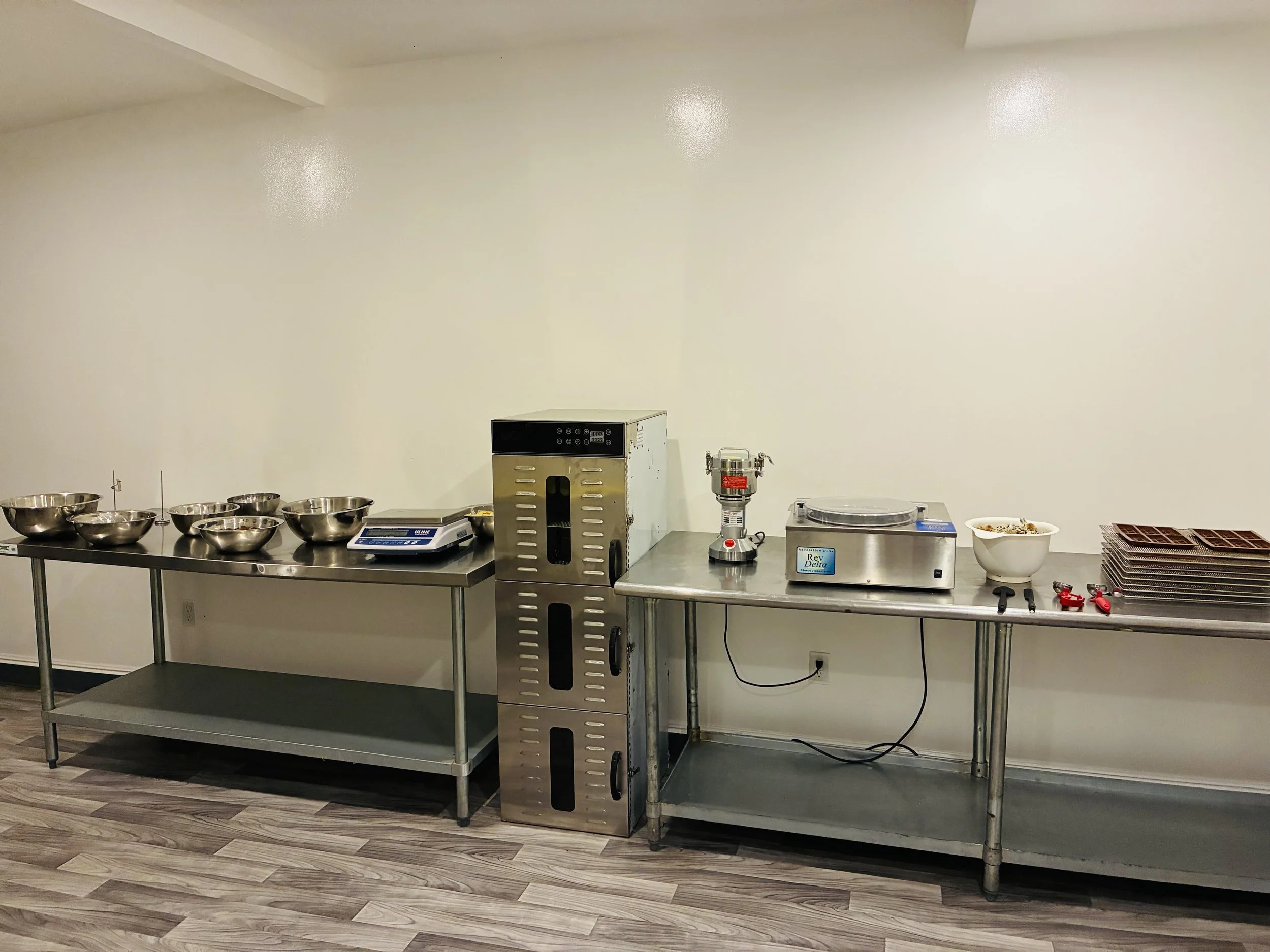
Our workshop.
A finished chocolate bar looks deceptively simple.
It’s smooth. It’s shiny. It has clean edges. It sits there looking as though it naturally appeared in that form—calm, polished, and completely unaware of the work that went into making it.
This is false advertising on chocolate’s part.
Long before a bar is wrapped, there’s measuring, mixing, temperature checking, mold preparation, cleaning, inspecting, waiting, and then cleaning everything again because chocolate has an almost supernatural ability to travel.
You can work carefully in one small area and somehow find a chocolate fingerprint on the opposite side of the room. No explanation. No witnesses.
It starts before the chocolate does
The first step isn’t pouring anything. It’s preparing the space.
Every surface, tool, and mold has to be clean, dry, and ready before we begin. Chocolate is not especially forgiving of improvisation, and once the process is moving, it’s a terrible time to discover that something you need is still sitting across the room.
So we set everything out. We inspect it. We clean things that are already clean. Then we inspect them again, partly because quality matters and partly because apparently this is just who we are now.
It isn’t the most exciting part to photograph, but it may be one of the most important. A beautiful finished product begins with a workspace that’s been prepared properly.
The polished bar at the end gets all the attention. The sanitized table receives no applause at all.
Simple ingredients still require attention
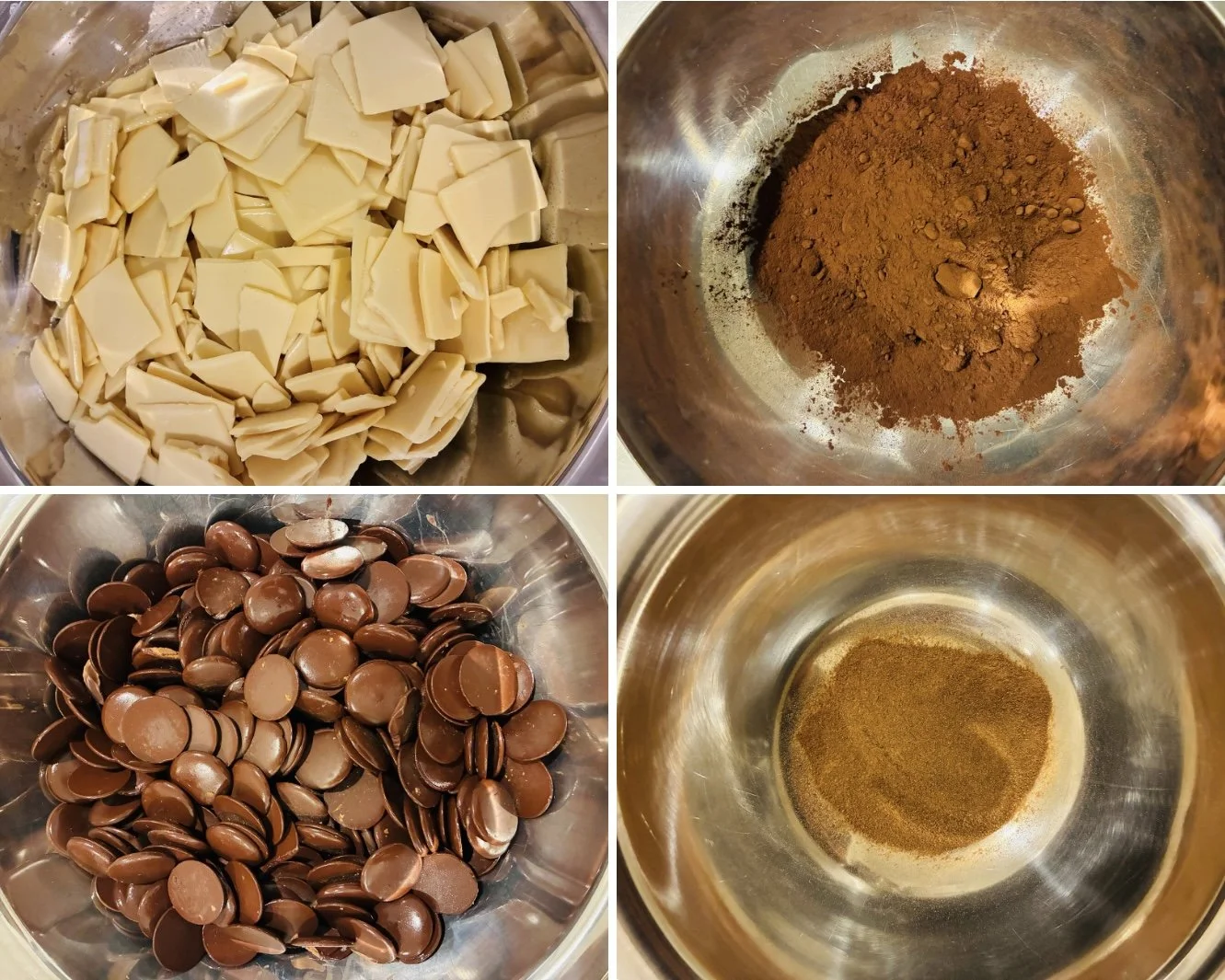
Simple ingredients.
We believe good chocolate begins with good ingredients, but choosing them is only the beginning.
Every ingredient has to be measured carefully and incorporated evenly. The goal is for the first piece of a batch to be just as consistent as the last—not roughly similar, not “close enough,” but something we can confidently stand behind.
That means paying attention when the process is repetitive.
Especially when it’s repetitive.
It’s easy to be careful during an exciting moment. The real test is maintaining that same level of attention while performing a task you’ve already done hundreds of times. Familiarity is helpful, but it can also make the brain wander into dangerous territory, like mentally reorganizing the entire building while your hands are supposed to be measuring something.
So we slow down. We check our work. We follow the same process every time.
Craftsmanship is often described as passion, creativity, and intuition. It is also a surprising amount of counting.
Chocolate has its own schedule
Chocolate responds to temperature, timing, movement, and probably the general emotional atmosphere of the room.
You cannot rush it simply because you have other things to do. You also cannot stare it into finishing faster, although that has never stopped us from trying.
It has to be handled within the right range and given the right amount of time. Too much heat, too little heat, too much movement, or not enough patience can change the finished texture and appearance.
This is where experience matters—not because experience eliminates every problem, but because it teaches you what to notice.
The way the chocolate moves can tell you something. Its texture can tell you something. The way it settles into the mold can tell you something.
Chocolate is very good at leaving clues. It is less good at providing written explanations.
Every mold gets individual attention
Once everything is properly combined, the chocolate is portioned into molds.
This is one of the more satisfying parts of the process, but it isn’t simply a matter of pouring and walking away. Each mold has to be filled carefully and checked for consistency. The chocolate needs to settle evenly, and anything that doesn’t look right has to be addressed before it sets.
There’s a rhythm to it: fill, check, adjust, repeat.
From a distance, it probably looks calm and methodical. Up close, it’s mostly intense concentration interrupted by someone asking, “Does this one look different to you?”
Then everyone looks at it from several angles as if it might confess.
Usually, it’s fine.
But “usually fine” isn’t the standard.
Waiting is part of the work
Eventually, the chocolate needs to be left alone.
This sounds easy. It is not.
Waiting is an important production technique that mostly consists of resisting the urge to interfere with something currently doing fine without you.
There’s always a temptation to check too early. Has it set? Is it ready? Would opening the door and staring at it help?
No. It would not.
So we wait. We clean the tools. We wipe down the workspace. We prepare packaging. We find the mysterious chocolate fingerprint across the room.
And then we wait a little longer.
The finished bars still have to earn it
Coming out of the mold does not automatically make a bar ready.
Each one is inspected for its finish, shape, texture, and overall consistency. Handmade products will always carry small signs that actual human beings made them, and we love that. But there’s a difference between character and carelessness.
If something doesn’t meet our standard, it doesn’t get waved through simply because we’ve already invested time in it.
That part can be frustrating. Nobody enjoys reaching the end of a process and deciding something isn’t good enough. But quality means the standard has to matter most when it would be convenient to ignore it.
The final inspection is where all the invisible work becomes visible—or, if we’ve done everything correctly, where it becomes invisible.
You don’t see the temperature checks.
You don’t see the measuring, cleaning, waiting, inspecting, or tiny adjustments made along the way.
You just see a chocolate bar that looks exactly as it should.
Handmade doesn’t mean casual

Fae Bae bars.
The word handmade can sometimes sound charmingly chaotic, like we’re standing in a kitchen improvising wildly and hoping the molds sort everything out.
Our process is much less romantic than that.
For us, handmade means the batch receives more attention, not less. It means someone is present for every stage—looking, checking, adjusting, and taking responsibility for the finished result.
Machines are very good at repetition. Human beings are good at noticing when something feels slightly off.
We use that attention deliberately.
It’s slower. It requires patience. It occasionally involves having a serious conversation about a mark on a chocolate bar that no reasonable person would ever notice.
But we would notice.
That’s the point.
More than what’s listed on the label
Of course, the ingredients matter. They always will.
But there’s more going into each bar than the ingredient list can explain: preparation, discipline, experience, cleanliness, patience, and a frankly unreasonable amount of attention to small details.
Most of that work disappears into the finished product.
And that’s exactly what’s supposed to happen.
The bar should feel simple.
We’ll handle the complicated part.